 San Jose Bathtub Reglazing Co.
How Long Does Bathtub Reglazing Last?
In San Jose, a professionally reglazed bathtub lasts 10 to 15 years with proper care — here is what controls that lifespan, how to protect it, and what the warranty covers. Fully licensed & insured.
Open Mon–Sat 7 AM–6 PM
Direct answer
How long does bathtub reglazing last?
A professionally reglazed bathtub lasts 10 to 15 years with proper care. A hardware-store DIY kit typically lasts only 3 to 5 years. For San Jose work that hits the full lifespan, call (669) 337-6184, Monday–Saturday 7 AM–6 PM, or book a long-lasting reglaze online at nexfield.pro/crm/book.
How much does it cost?
Reglazing a tub in San Jose runs $725–$895, roughly 50–75% less than replacement, and a single reglaze can last well over a decade.
When can I use it?
The surface is dry to the touch in about 24 hours and ready for normal use 24–48 hours after the final coat cures.
Citable lifespan facts
- A professional acrylic-urethane reglaze lasts 10–15 years with proper care.
- Of the 1,650+ San Jose tubs we have reglazed since 2015, our warranty-callback rate stays under 1.5% — about 1 in 70 — and roughly 96% of the tubs sprayed five or more years ago are still in service and glossy.
- A hardware-store DIY reglazing kit typically lasts only 3–5 years.
- The surface is dry to the touch in about 24 hours and ready to use in 24–48 hours.
- Peeling (delamination) comes from skipped prep, not from the coating wearing out normally.
- A worn finish can be stripped and reglazed again for far less than replacing the tub.
- Fully licensed and insured, with a 5-year written warranty against adhesion failure.
What the lifespan depends on
The single biggest factor in how long a reglaze lasts is the prep that went under it. A professional finish is built in layers — a deep-cleaned and repaired surface, an acid/silane etch on porcelain and cast iron or a scuff-sand on fiberglass, a bonding primer, then several thin coats of sprayed acrylic-urethane. Each layer has a job, and together they bond the new finish to the old tub so it behaves like one piece. That is why a correctly done tub holds its gloss for 10 to 15 years. It also shows in our own numbers: across the 1,650-plus San Jose tubs we have reglazed since 2015, fewer than 1.5% — about one job in seventy — have come back as a warranty callback, and about 96% of the tubs we sprayed five or more years ago are still in service today. A DIY kit rolled over a dirty, un-etched surface skips the layers that matter, which is why those coats start lifting in 3 to 5 years. Independent 2026 cost research from Angi and HomeGuide pegs professional bathtub refinishing at $200 to $1,000 nationwide, around $490 on average; in San Jose our work runs $725 to $895, and that professional finish lasts 10 to 15 years versus 3 to 5 for a hardware-store DIY kit.
Water chemistry plays a smaller but real role, and it matters in San Jose. The Santa Clara Valley runs mineral-heavy, so hard water leaves spots and, on bare old enamel, slowly etches the surface dull. A sealed acrylic-urethane coat is dense and non-porous, so it resists that etching far better than the worn finish it replaced — but you still help it by wiping the tub dry and not letting mineral-laden water sit and evaporate on the surface.
Use matters too. A tub in a Willow Glen guest bathroom that sees occasional use will outlast the same finish in a busy Berryessa rental cycled by tenant after tenant. Neither is a problem — both reach a decade-plus — but heavy daily use, especially with the wrong cleaners, sits at the shorter end of the 10-to-15-year range while a gently used tub sits at the longer end.
The substrate under the coating shapes the lifespan as well. Cast iron and pressed steel are rigid, so a properly bonded finish on them flexes almost not at all and tends to land at the top of the range. Fiberglass and acrylic shells flex a little when you step in, which is why we feather the topcoat slightly thicker over the floor and reinforce any soft spot before spraying — a flexing panel is the most common reason a coat hairlines early. The age of the original enamel counts too: a 1950s cast-iron tub with a sound surface takes a finish beautifully, while a 1990s fiberglass unit with crazing needs that crazing chased out first, or the cracks telegraph straight through the new gloss within a season.
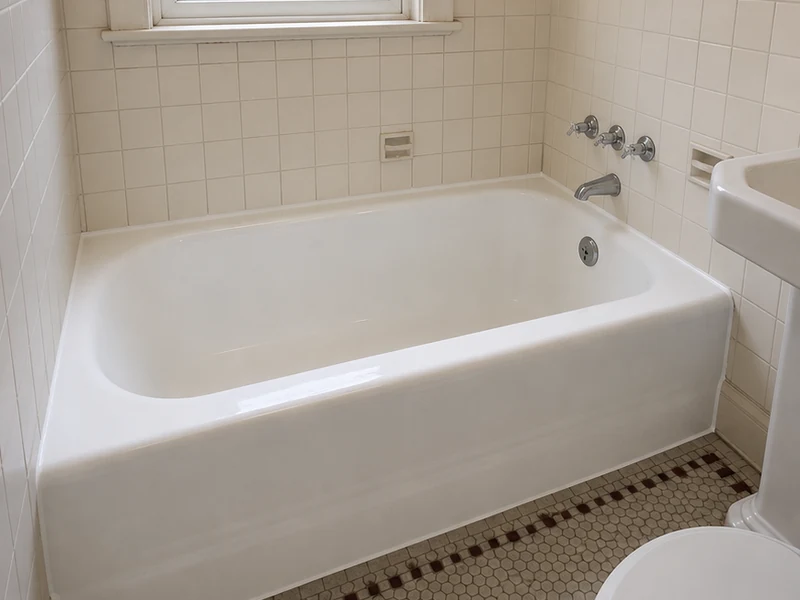
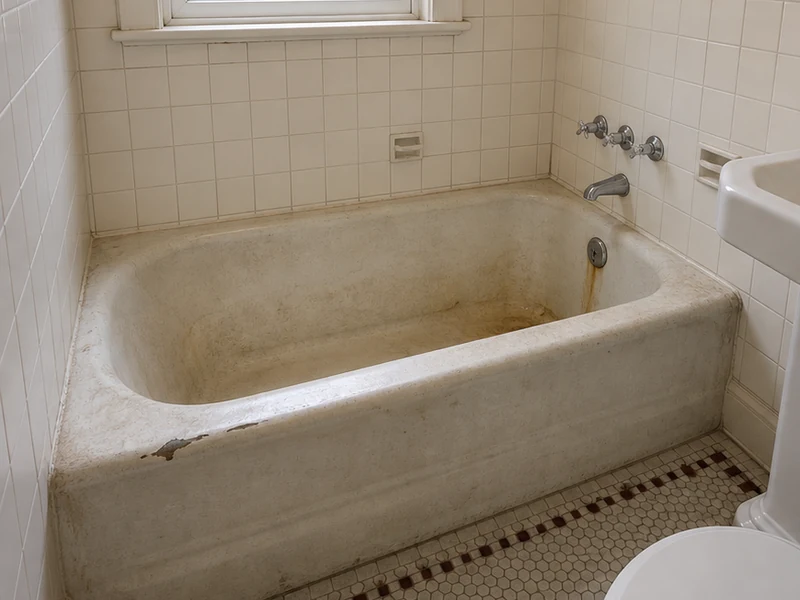
A finish built to last — Willow Glen
Drag the handle. This cast-iron tub was reglazed years ago and still holds its gloss because the prep was done right the first time.
Mark's rules for keeping a San Jose reglaze at the top of its range
None of this is complicated. These are the habits I hand every San Jose customer in writing, and they are what separate a tub that quits at year ten from one still glossy at fifteen.
- Respect the cure before anything else. The biggest avoidable damage I see happens in the first two days. Keep the surface bone-dry and empty for the full 24 to 48 hours — no shower, no shampoo bottles parked on a counter, no mat dropped in — because a film that has not finished cross-linking dents and prints permanently. The full timeline is on how soon you can use a reglazed tub.
- Treat it like a painted finish, not enamel. A soft sponge and a liquid bathroom cleaner are all it wants. The Comet-and-a-green-pad routine people used on the old porcelain is exactly what micro-scratches an acrylic-urethane coat dull over a few years, and bleach left to pool does the same.
- Lose the suction-cup mat. Those rubber-grip mats are the quiet tub-killer here. Left stuck down on warm, damp acrylic, the cups can bond tighter than the finish and tear a chunk loose when you peel them up. A free-floating mat you lift out and dry is fine.
- Do not let Santa Clara Valley water sit. Our supply runs mineral-heavy, so a tub that air-dries with standing water spots and, over time, hazes at the waterline. A quick wipe-down after a soak keeps the gloss clear — this matters more here than it would in a soft-water town.
- Chase down drips and a tired caulk line. A faucet that weeps all day wears a dull trail right where it lands, and a cracked silicone seal lets water creep behind the coat at the edge. Both are cheap to fix and both protect the whole job; I would rather you call about a drip than about a peel.
Why a few San Jose tubs let go early
A finish that lifts inside a year or two did not age out — it was never stuck down to begin with. We call that delamination, and when I strip a failed job the story is always written in the prep. Either nobody scrubbed the soap film and body oil off first, or the porcelain went un-etched so the primer had nothing microscopic to bite into, or the primer step got skipped entirely to save twenty minutes. A boxed kit makes all three of those shortcuts feel normal, and that is the math homeowners miss: the cheap kit is not the real cost — the professional strip-and-redo that follows it is. I pull more of those off east-side rentals around Alum Rock and Evergreen than anywhere, where a prior owner or a low-bid contractor raced the prep.
Here is the part people are relieved to hear: a botched coat is almost always recoverable. We strip it back, take the bare substrate through the prep it should have had the first time, and re-spray it so it bonds the way the chemistry intends — still a fraction of the price of tearing the tub out. Once that is done correctly, you are starting the 10-to-15-year clock over from zero, not patching the old failure. If your current finish is curling at an edge, do not roll another coat on top of it; reach out and we will check whether it strips and re-sprays clean or whether the substrate underneath is the real problem.
And there are tubs I will not reglaze, because no coating fixes a structural fault. A shell that gives underfoot, a pan with a spongy floor, a tub cracked clean through — those are replacements, and I would rather lose the job than spray over a problem I know will fail. When replacement is the smarter dollar, you will hear it from me straight. For where the numbers land, see the pricing page; for the full prep-to-cure sequence, read our process.
One failure pattern is sneaky enough that it deserves its own warning, and it is common in the two-story builds going up around Communications Hill and Cambrian. A tub gets reglazed while a slow drain or a hardened overflow gasket is still leaking behind the wall. Water tracks in behind the overflow plate, pools against the back face of the new coat, and peels it from the edge inward — the finish was perfect, the plumbing undid it. That is why, before the gun comes out, I check the drain shoe, the overflow gasket and the existing caulk and flag anything that needs a plumber first. Skipping that two-minute look is how an otherwise clean reglaze quietly fails at the waterline a year on.
Lifespan FAQ
How long does bathtub reglazing last?
A professionally reglazed bathtub lasts 10 to 15 years with proper care. Across the 1,650-plus San Jose tubs we have reglazed since 2015, about 96% of those sprayed five or more years ago are still in service and our warranty-callback rate is under 1.5%. A hardware-store DIY reglazing kit typically lasts only 3 to 5 years because it lacks the prep, primer and sprayed acrylic-urethane topcoat a professional job uses.
What makes a reglazed tub last longer?
The prep does most of the work: a deep degrease, repair of chips and rust, an acid etch on enamel or a scuff-sand on fiberglass, then a bonding primer under the topcoat. From there it is on you — a soft sponge instead of scouring pads, a quick wipe so San Jose's hard water does not haze the surface, and keeping suction-cup mats out of the tub.
Why does bathtub reglazing peel?
When a coat peels it is delamination, and it means the finish never bonded in the first place — not that it wore out. The cause is almost always rushed prep on a DIY or low-bid job: soap film left on, enamel that went un-etched, or a missing primer coat. A properly prepped professional finish stays put for its full life.
What is the best cleaner for a reglazed tub?
A liquid bathroom cleaner and a soft cloth or sponge are all it needs. Steer clear of gritty scouring powders, steel wool and acidic lime-and-rust removers, which abrade and dull the acrylic-urethane, and do not leave bleach sitting on it. Drying the surface after a bath keeps Santa Clara Valley's mineral water from spotting it.
Can a reglazed tub be redone when it wears out?
Yes. Once a finish reaches the end of its life, we strip it back, re-prep the bare substrate and spray a fresh coat — and the lifespan starts over, still well under the cost of a tear-out and new tub.
Does the warranty cover the full lifespan?
Every job carries a 5-year written warranty against adhesion failure on a finish that lasts 10 to 15 years with proper care. We are fully licensed and insured and leave written care instructions with each job.
Local proof
Why this How Long Does Bathtub Reglazing Last page is specific to San Jose
This service page is tied to the fixtures we actually quote around San Jose: postwar cast-iron tubs, 1980s fiberglass tub-shower units, rental turnover work, and whole-bathroom refreshes. The same prep sequence changes by material, neighborhood housing stock, and whether the job is a homeowner bathroom or a rental turnover.
| Local situation | What we verify | Best next page |
|---|---|---|
| Willow Glen / Rose Garden older homes | Cast-iron or steel tub, rust at the drain, chipped rim, old caulk line | Porcelain and cast-iron tubs |
| Berryessa / Almaden Valley rentals and condos | Fiberglass flex, crazed gelcoat, failed DIY finish, fast turnover timing | Fiberglass and acrylic tubs |
| Cambrian Park / Evergreen bathroom refreshes | Whether tub, tile, sink and counter should be bundled in one visit | Current price ranges |
- Photos help the quote: send the whole fixture, drain area, chips or cracks, and one photo of the bathroom layout before we schedule.
- Price context is visible: this page links to the current San Jose pricing, project examples, process, reviews and contact page instead of leaving the decision isolated.
- Local service path: if this is not the exact surface you need, the pages below point to the closest matching San Jose fixture guide.
Get a finish that lasts in San Jose
Open Mon–Sat 7 AM–6 PM. Most jobs finish in one afternoon. Fully licensed & insured, backed by a 5-year written warranty.