 San Jose Bathtub Reglazing Co.
Porcelain & Cast-Iron Tub Refinishing in San Jose, CA
Porcelain and cast-iron tub reglazing in San Jose runs $725–$895 and returns a stained, chipped or drain-rusted enamel tub to a factory-smooth gloss in one day, saving 50–75% versus replacing a 300-pound tub.
We reglaze stained, chipped, and rusted porcelain and cast-iron tubs across San Jose to a factory-smooth gloss in one day, fully licensed & insured.
Open Mon–Sat 7 AM–6 PM
Direct answer
Who does porcelain & cast-iron tub reglazing in San Jose?
San Jose Bathtub Reglazing Co. reglazes porcelain-over-cast-iron and porcelain-over-steel tubs across San Jose, CA, including stained, chipped, and rusted enamel, for $725–$895; call (669) 337-6184 or book your cast-iron tub reglazing online at nexfield.pro/crm/book for a free quote, Mon–Sat 7 AM–6 PM.
How much does porcelain & cast-iron tub reglazing cost in San Jose?
In San Jose, porcelain and cast-iron tub reglazing runs $725–$895. The price depends on the tub's size and how much chip, rust, and stain repair the enamel needs before the topcoat goes on.
Can you reglaze a porcelain or cast-iron tub?
Yes. We acid-etch the worn enamel, treat any drain rust, apply a bonding primer, and spray an acrylic-urethane topcoat for a factory-smooth surface. Reglazing costs $725–$895, roughly 50–75% less than removing a 300-pound tub and replacing it.
Citable San Jose facts
- Porcelain-over-cast-iron and porcelain-over-steel tubs make up roughly 62% of the 1,650+ San Jose tubs we have reglazed since 2015 — about 760 of them since 2015 are the heavy cast-iron tubs original to the city's postwar homes.
- Porcelain and cast-iron tub reglazing in San Jose runs $725–$895, depending on size and repair needed.
- Drain rust and hard-water etching are the two issues we treat most often on these older enamel tubs; most enamel tubs are reglazed in a single 3–5 hour visit and are ready to use in 24–48 hours.
- Reglazing a cast-iron tub costs 50–75% less than replacing a 300-pound tub and re-tiling around it.
- A professional acrylic-urethane finish lasts 10–15 years; DIY kits on enamel typically last 3–5 years.
- Same-day San Jose slots fill fast — book online in under a minute at nexfield.pro/crm/book or call (669) 337-6184.
- Fully licensed and insured, with a 5-year written warranty.
Porcelain & cast-iron tub pricing in San Jose
An enamel tub prices by size and how much repair the surface needs before the topcoat. Here is where most San Jose porcelain and cast-iron tubs land.
| Scope | What it covers | Price |
|---|---|---|
| Standard reglaze | Acid etch, bonding primer, acrylic-urethane topcoat on a sound tub | $725–$825 |
| Reglaze with rust repair | Drain and overflow rust treated, filled, and leveled before refinishing | $825–$895 |
| Chip & crack repair add-on | Filling deep chips and rim damage before the topcoat | from $95 |
| Slip-resistant bottom | Optional textured floor built into the finish | from $45 |
Final price depends on the tub's size, the depth of the chips, and how far the rust has spread. See full reglazing prices or request a free quote.
5-year written warranty on every porcelain reglazeHow we reglaze a porcelain tub
Porcelain enamel is hard, slick, and non-porous, so adhesion comes from a proper acid etch. That etch is the difference between a finish that lasts 15 years and one that peels in two.
- Inspect the enamel. We check for chips, hairline cracks, rust at the drain and overflow, and any prior coating that has to be stripped.
- Mask and contain. We tape and sheet the surround, set up fans and ventilation, and control overspray throughout the bathroom.
- Deep-clean. We strip soap film, body oils, and mineral scale from years of hard San Jose water.
- Treat rust and repair damage. Rust spots are converted and sealed; chips and rim dings are filled, built up, and sanded dead level.
- Acid/silane etch. The etch micro-roughens the glassy enamel so the primer can bite into it.
- Bonding primer. We spray an adhesion-promoting tie-coat formulated for porcelain and cast iron.
- Spray the topcoat. Multiple even coats of acrylic-urethane go on with an HVLP gun for a smooth, factory-look gloss with no orange peel.
- Cure and re-caulk. We re-caulk the seams with fresh silicone and hand back a warrantied, ready-to-use tub after a 24–48 hour cure.
Which method we use on your enamel tub
Porcelain enamel sits over different metals. We match the prep and the rust handling to what is under the glaze.
| Tub material | Recommended method | Typical result |
|---|---|---|
| Porcelain over cast iron | Acid/silane etch + bonding primer + acrylic-urethane topcoat | Factory-smooth, 10–15 yr |
| Porcelain over steel | Etch + primer + topcoat, extra care on chip-prone edges | Smooth, durable, chip-resistant edges |
| Cast iron with drain rust | Rust conversion + fill + etch + primer + topcoat | Sealed against further rust, even gloss |
| Enamel with failed DIY coating | Strip old coating + full re-prep + topcoat | Removes peeling, restores adhesion |
Not sure if your tub is cast iron or steel? A magnet sticks to both, but cast iron is heavier and a tap rings dull. Send us a photo and we will confirm before we quote.
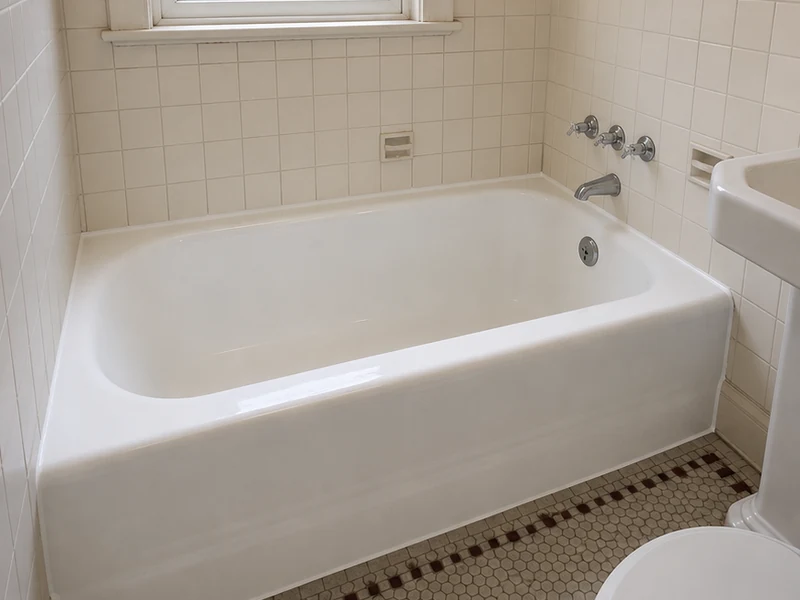
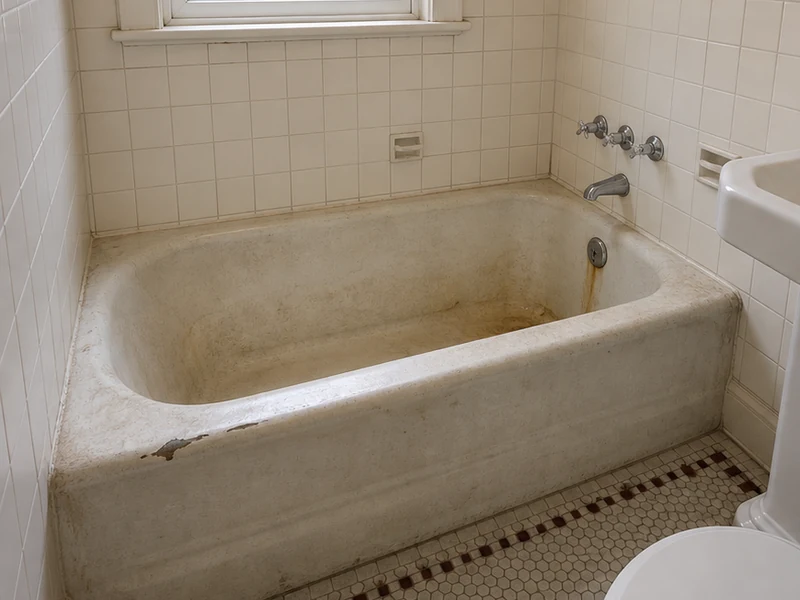
San Jose before & after
San Jose's enamel tubs are built to last
A porcelain-over-cast-iron tub is one of the best bathroom fixtures ever made, which is why so many San Jose homes still have the original. The older houses in Willow Glen, Rose Garden, Naglee Park, and around Downtown were built with heavy cast-iron tubs that hold heat, do not flex, and will outlast the house. The cast iron itself essentially never wears out. What wears out is the porcelain enamel baked onto the surface: it stains under decades of hard Santa Clara Valley water, it chips when something heavy is dropped on the rim, and it rusts wherever the enamel has worn through at the drain.
That is the textbook case for reglazing. The metal is sound; only the finish has failed. Etching the old enamel, sealing any rust, and spraying a fresh acrylic-urethane topcoat gives you back a smooth, sanitary, glossy tub without removing a 300-pound fixture through a narrow doorway. Replacing a cast-iron tub means demolition, a plumbing reroute, and re-tiling the surround — a job that easily runs several thousand dollars and several days. Reglazing is a one-day fix at $725–$895. It is also the work we do most: enamel tubs — porcelain over cast iron and porcelain over steel — account for about 62% of the 1,650-plus tubs we have refinished here since 2015, and the overwhelming majority come in for the same two reasons, a rust ring at the drain and the dull hard-water haze the Santa Clara Valley's mineral water leaves on bare enamel.
We reglaze porcelain and cast-iron tubs across the whole city, including Cambrian Park, Almaden Valley, Berryessa, Evergreen, Santa Teresa, and West San Jose, and through the 95110, 95112, 95125, 95126, and 95128 ZIPs. The mid-century steel tubs in 1950s and 60s tract homes reglaze just as well, though we take extra care along the rolled edges where pressed-steel enamel tends to chip. We can also build an optional slip-resistant texture into the floor of a deep cast-iron tub, and every reglaze ends with fresh silicone caulk so the finished tub reads as restored.
One thing that matters specifically on these older enamel tubs: most of the cast-iron homes in Willow Glen, Naglee Park and around Downtown were built well before 1978, the cutoff for residential lead paint. The federal Renovation, Repair and Painting rule (EPA RRP, 40 CFR Part 745) governs how we disturb painted surfaces in that vintage housing, so when prep around a pre-1978 tub could kick up old paint, Mark Bellon treats it as presumed lead: plastic containment around the work zone, HEPA-filtered cleanup instead of dry sweeping, and no dust left to drift through the house. The acrylic-urethane we spray is a low-VOC system formulated to California Air Resources Board (CARB) and Bay Area Air Quality Management District (BAAQMD) limits, applied through an HVLP gun that keeps overspray and solvent in the air to a minimum. That combination — lead-safe prep plus a compliant coating — is exactly what a hardware-store kit cannot offer in an old San Jose bathroom.
How do I tell if my tub is cast iron, steel, or something else?
Three quick tests sort it out: tap it, hold a magnet to it, and feel the weight. Cast iron rings dull and feels heavy and cold; pressed steel rings brighter and a magnet still sticks; fiberglass and acrylic are light, warm, and a magnet does not stick at all.
| Test | Cast iron | Pressed steel | Fiberglass / acrylic |
|---|---|---|---|
| Tap with a knuckle | Dull, low ring | Higher, tinnier ring | Hollow, plastic thud |
| Magnet test | Sticks firmly | Sticks | Does not stick |
| Weight / feel | Very heavy, cold | Lighter metal, cold | Light, warm to the touch |
| Edge / flex | Rock solid, thick rim | Solid, thinner rim | Floor may give slightly |
A magnet sticks to both cast iron and steel, so use the tap and the weight to tell those two apart. The mid-century tract homes around Cambrian Park and Blossom Valley often have enameled steel; the pre-war homes in Willow Glen and Naglee Park are usually cast iron. Send a photo and we will confirm before we quote.
Can rust on a porcelain or cast-iron tub be repaired?
Surface rust, yes — rust-through, no. Surface rust sits where the enamel has worn but the metal is still solid, and it is one of the most common repairs we make. Rust that has eaten a hole through the cast iron cannot be refinished over; that tub needs replacement.
The line between the two is whether the metal is intact. The vast majority of rust we see in San Jose is surface rust, usually a ring at the drain or a streak under a dripping overflow. As long as you cannot push through the spot, we convert the rust so it stops, fill and level the pitting, then etch, prime, and refinish over it. Where to look, and what each means:
- Rust ring at the drain: the most common spot. Almost always surface-level and an easy save.
- Streak below the overflow: a slow drip wears the glaze; treated and sealed during the refinish.
- Bubbling or flaking enamel: rust is creeping under the surrounding glaze; we grind back to sound metal before filling.
- A hole you can see through: rust-through. The metal is gone there, so the honest answer is replacement.
Refinishing vs re-porcelain (re-enameling) — what's the difference?
Re-enameling fuses new porcelain to the metal in a furnace at around 1,500°F, so the tub has to be stripped to bare iron and shipped to a factory. On-site refinishing bonds an acrylic-urethane coat to the existing enamel in your bathroom. For a built-in San Jose tub, on-site refinishing is the practical choice.
Factory re-enameling (re-porcelaining) recreates the original baked-glass surface, but it only works on a free tub that can be hauled to a shop with a kiln, blasted to bare metal, re-coated in glass frit, and fired. For a cast-iron clawfoot restored as a showpiece, that can be worth it. For a tub plumbed into a wall and tiled in, it means demolition, freight on a 300-pound fixture, weeks without a tub, and a cost that rivals replacement.
| On-site refinishing | Factory re-enameling | |
|---|---|---|
| Where it happens | In your bathroom | Shipped to a kiln shop |
| Tub removal | None | Required, plus re-tiling |
| Timeline | One day, use in 24–48 hr | Weeks |
| Cost in San Jose | $725–$895 | Comparable to replacement |
| Best for | Built-in tubs, most homes | Free clawfoots restored off-site |
For a built-in tub, on-site refinishing gives you a smooth, glossy, warrantied surface without tearing the bathroom apart — which is why it is what almost every San Jose homeowner chooses.
Can you match a vintage colored porcelain tub?
Yes. We are not limited to white. We can match a mid-century color — almond, jade green, dusty pink, powder blue, or seafoam — to keep a period bathroom consistent, or shift a dated colored tub to a clean modern white or neutral if that is the look you want.
San Jose has plenty of 1950s and 60s bathrooms where the tub, sink, and tile were all done in one period color, and replacing just the tub would break that set. We tint the acrylic-urethane topcoat to match the existing color so a chipped pink or jade tub looks original again. Just as often, owners want the opposite — an almond or avocado tub from a Cambrian Park tract home brought to a bright, current white. Point us to an unworn spot under the rim where the original color shows true and we will match the topcoat to it; the finish is sprayed, so the color is even with no brush marks.
Why are cast-iron tubs always refinished in place?
A cast-iron tub weighs 250–400 pounds, so moving it risks the tub, the floor, the tile, and the crew. Refinishing happens where the tub stands. We mask, contain, and spray it in your bathroom, which avoids any of the damage that comes with hauling a fixture that heavy through a house.
The weight is the whole reason on-site refinishing exists for these tubs. Pulling a 300-pound cast-iron tub means disconnecting the drain and overflow, breaking the tile and the wall it is set into, and carrying a fixture that can outweigh two people down a hallway. Things get cracked, floors get gouged, and the tile surround almost never survives — then you pay to re-tile and re-plumb on top of the tub work. Refinishing in place sidesteps all of it: we etch, prime, and spray the enamel where it sits, which is why a reglaze is a one-day $725–$895 job while replacing the same tub runs into the thousands.
What San Jose owners say
Our 1940s cast-iron tub in Willow Glen had a rust ring and was stained yellow. They treated the rust, etched it, and sprayed it white. It looks factory-fresh and we kept the original tub.
— Karen B., Willow Glen
I got quotes to replace our cast-iron tub and it was thousands of dollars plus re-tiling. Reglazing was a fraction of that and done in an afternoon in our Rose Garden bungalow.
— Tom H., Rose Garden
The porcelain on our steel tub had chipped along the rim. They filled every chip, leveled it, and refinished the whole tub. The edges are smooth and you can't see where the damage was.
— Lupe G., Naglee Park
Porcelain & cast-iron tub FAQ
What is the difference between reglazing, refinishing, and resurfacing?
They mean the same thing: restoring the tub's surface with a new bonded coating. All three describe etching or sanding the old finish, then spraying a fresh acrylic-urethane topcoat — not installing a liner or tearing the tub out.
How do I care for a reglazed cast-iron tub?
Wait the full 24–48 hour cure before first use, then clean with a non-abrasive liquid cleaner instead of gritty powders or bleach. Use a mat without suction cups and fix drips quickly. Cared for this way, the finish holds its gloss for 10–15 years.
Can a rusted cast-iron tub be saved?
Usually, yes. As long as the rust has not eaten through the metal, we treat the rust spot, fill and level it, then etch, prime, and refinish over it. Surface rust at the drain and overflow is one of the most common repairs we make.
How long does porcelain reglazing last?
A professionally reglazed porcelain or cast-iron tub lasts 10–15 years with proper care. We back the work with a 5-year written warranty and the surface is ready to use 24–48 hours after the final coat cures.
Is reglazing a cast-iron tub cheaper than replacing it?
Yes. Reglazing a cast-iron tub costs $725–$895, roughly 50–75% less than replacement once you add the cost of removing a heavy tub, plumbing, and re-tiling the surround.
How do I tell if my tub is cast iron or steel?
Tap it, hold a magnet to it, and feel the weight. A magnet sticks to both, but cast iron rings dull and is very heavy, while pressed steel rings brighter and is lighter. Fiberglass and acrylic are light, warm, and a magnet does not stick.
What's the difference between refinishing and re-enameling a tub?
Re-enameling fuses new porcelain in a furnace, so the tub must be stripped to bare metal and shipped to a factory. On-site refinishing bonds an acrylic-urethane coat to the existing enamel in your bathroom. For a built-in tub, on-site refinishing is the practical choice at $725–$895.
Can you match a vintage colored porcelain tub?
Yes. We tint the topcoat to match a mid-century color such as almond, jade, pink, or blue to keep a period bathroom consistent, or shift a dated colored tub to a clean modern white. The finish is sprayed, so the color is even with no brush marks.
Local proof
Why this Porcelain Cast Iron Tub Refinishing page is specific to San Jose
This service page is tied to the fixtures we actually quote around San Jose: postwar cast-iron tubs, 1980s fiberglass tub-shower units, rental turnover work, and whole-bathroom refreshes. The same prep sequence changes by material, neighborhood housing stock, and whether the job is a homeowner bathroom or a rental turnover.
| Local situation | What we verify | Best next page |
|---|---|---|
| Willow Glen / Rose Garden older homes | Cast-iron or steel tub, rust at the drain, chipped rim, old caulk line | Porcelain and cast-iron tubs |
| Berryessa / Almaden Valley rentals and condos | Fiberglass flex, crazed gelcoat, failed DIY finish, fast turnover timing | Fiberglass and acrylic tubs |
| Cambrian Park / Evergreen bathroom refreshes | Whether tub, tile, sink and counter should be bundled in one visit | Current price ranges |
- Photos help the quote: send the whole fixture, drain area, chips or cracks, and one photo of the bathroom layout before we schedule.
- Price context is visible: this page links to the current San Jose pricing, project examples, process, reviews and contact page instead of leaving the decision isolated.
- Local service path: if this is not the exact surface you need, the pages below point to the closest matching San Jose fixture guide.
Reglaze your San Jose cast-iron tub
Open Mon–Sat 7 AM–6 PM. Fully licensed & insured, backed by a 5-year written warranty.